
By the 247 AI Marketing team · Content, video and digital marketing for growing businesses
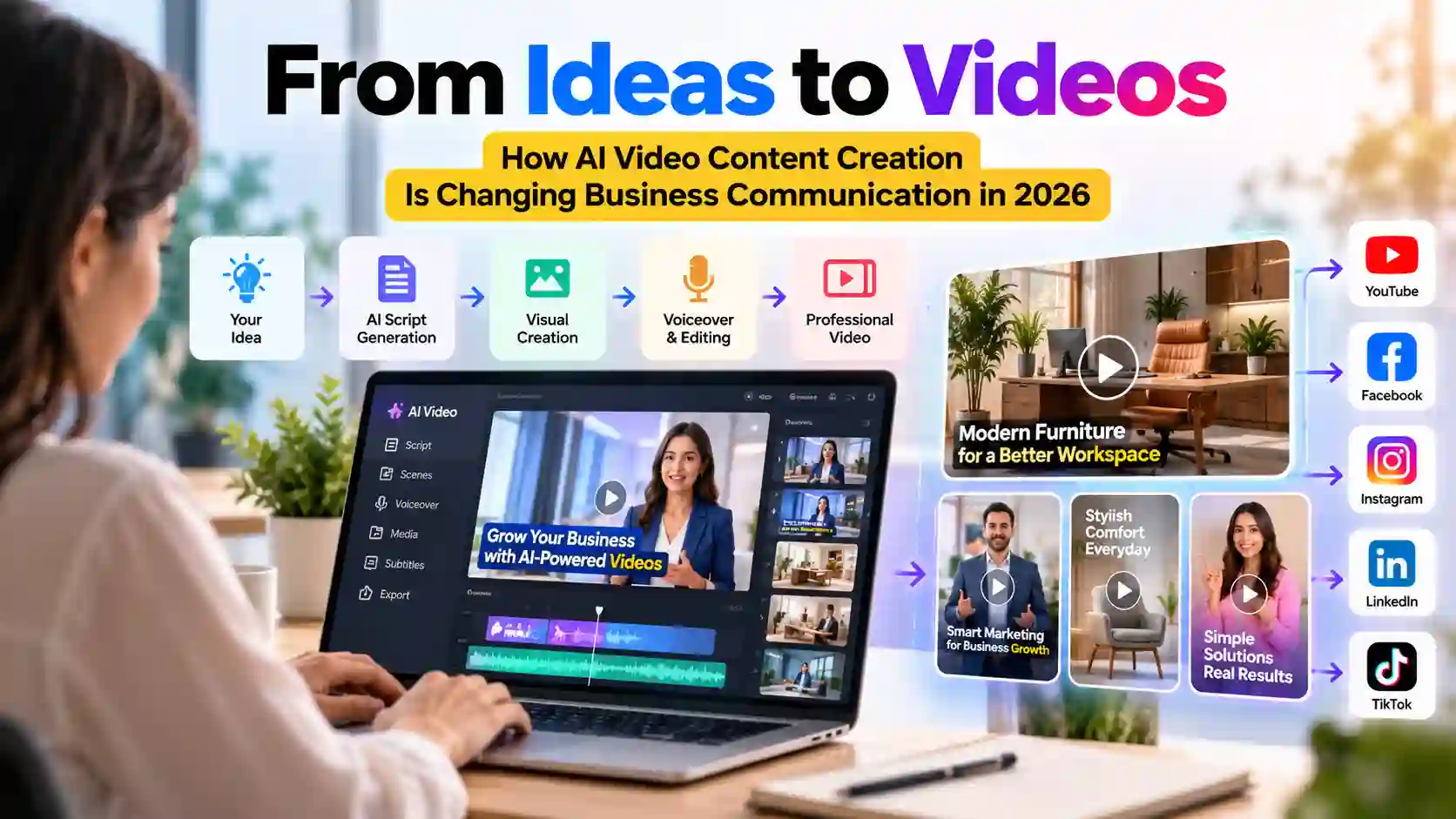
From Ideas to Videos: How AI Video Content Creation Is Changing Business Communication in 2027
Every business has something valuable to communicate: a furniture brand wants to show its latest collection, an agency wants to explain its services, an online store wants customers to understand how its products work. The challenge is turning those ideas into engaging content consistently. This guide shows how to turn everyday marketing ideas into useful video, build a repeatable workflow and choose the right formats.
Quick answer: AI video content creation for businesses uses artificial intelligence to help turn ideas, text, images, product information or existing media into video, assisting with scripting, visual planning, narration, animation and editing. It works best with one clear message, the right production method for that message, and human review before publishing. A video still needs accurate information, relevant visuals and a reason for people to watch.
What is AI video content creation for businesses?
It means using AI tools to help transform ideas, text, images, product information or existing media into video. Depending on the platform, these tools can assist with generating scenes, creating animated visuals, producing voiceovers, adding subtitles, editing footage and adapting videos to different formats.
A company with a detailed service page could develop a short explainer from its main points. An online retailer could use product information to prepare a script. A professional services firm could turn frequently asked questions into educational clips. The aim is to make production more flexible and manageable while keeping the finished content accurate to the business.
| Activity | Example |
|---|---|
| Explaining | Products and services |
| Introducing | A new brand or product collection |
| Repurposing | Blog articles turned into short educational videos |
| Social media | Prepared content for social platforms |
| Training | Internal training materials |
| Demonstrating | Processes and workflows |
| Advertising | Creative concepts for campaigns |
The most appropriate use depends on your message, audience, available resources and the level of visual accuracy required.
Why businesses are rethinking their video production process
Traditional production remains valuable, especially for real people, authentic locations or detailed product demonstrations. But many businesses need a more flexible way to publish regularly. AI-assisted production opens four possibilities.
1. Turning written information into visual content
Reuse what you already have
Websites, brochures, product descriptions, presentations and blog articles hold a lot of information. AI tools can help identify key points and turn them into scripts or storyboards. A digital marketing agency could turn an article on website optimization into a short video on three common website problems. The original article stays available for readers who want detail.
2. Exploring creative ideas before production
Decide how it should look before you invest
Concept visuals can help teams explore settings, visual styles, scene sequences and storytelling approaches. A furniture company could explore several conceptual office layouts to plan a campaign around modern workspace design. Generated visuals must not be presented as photographs of real projects or products when they are not.
3. Creating content for different audiences
Adapt meaningfully, not cosmetically
A beginner may need a simple introduction, while an experienced buyer wants specifications, implementation or support details. AI-assisted workflows can help develop alternative scripts and formats for each. Adapt the information itself rather than changing a few words and leaving the content irrelevant to the audience.
4. Making video production more repeatable
A clear process beats starting from scratch
Templates, reusable brand assets, script structures and editing workflows reduce repetitive work on each new video. AI can support parts of the process and help maintain consistency, while leaving room for original ideas and human creative judgment.
A practical 7-step workflow for creating business videos with AI
A structured workflow helps you produce videos that are useful, accurate and aligned with your communication goals. Click through the steps below.
Workflow stepper
Five types of AI-assisted videos businesses can create
The value of AI video creation becomes clearer when it is tied to a specific business need. Pick a type to see what it does and what to watch for.
Video types
How different industries can apply AI video creation
AI-assisted video is not limited to companies selling digital products. It adapts to many industries when the chosen format fits the business.
| Industry | Video ideas | Verify before publishing |
|---|---|---|
| Retail and e-commerce | Product explainers, collection introductions, usage guides, seasonal promotions. An online home accessories store could show how products fit into a room design. | Product descriptions, specifications and visual representations |
| Real estate and interior design | AI-generated concepts to explore layouts, styles and design directions | Clearly separate conceptual images from actual properties or completed projects; keep real listings accurate |
| Professional services | Educational videos on common questions and processes; FAQs turned into short video series | Accuracy of any professional information |
| Hospitality and restaurants | Service introductions, experiences, events and visitor information | Menus, facilities, locations and services shown honestly; no expectations the business cannot fulfill |
| Education and training | Visual explanations, lesson introductions, training modules, supplementary materials | Subject-expert check of explanations, examples and demonstrations |
How to choose the right AI video creation tools
No single AI video platform is best for every business. The right choice depends on the content you want to create and the control you need. Evaluate these capabilities before committing.
| Capability | Useful when |
|---|---|
| Text-to-video generation | You need to develop visual scenes from written descriptions |
| Image-to-video generation | You want to animate suitable images or build motion concepts from existing assets |
| AI-assisted editing | You are trimming footage, restructuring content, adding captions or preparing versions |
| Voiceover generation | The selected voice and language suit your audience |
| Avatar-based video | You are making presentations, educational explainers or certain training materials |
| Branding features | Templates, fonts, colors and reusable assets need to stay consistent |
| Export and platform compatibility | The tool must support the formats and quality your channels require |
| Commercial usage terms | You need to review licensing for generated content, voiceovers, music and other assets |
Common mistakes to avoid when creating AI videos
AI makes some tasks easier, but these mistakes can reduce the value of the final content.
| Mistake | What to do instead |
|---|---|
| Creating videos without a clear objective | Give each video a specific communication purpose, or it may look attractive and still fail to inform |
| Relying entirely on generic AI scripts | Generated scripts can be vague, repetitive or make unsupported claims. Add real business knowledge, examples and accurate details |
| Ignoring brand consistency | Use consistent visual guidelines, terminology and messaging, adapted to each video’s purpose |
| Using inaccurate visuals | AI can introduce details not in the source. Inspect carefully and use verified assets where accuracy matters |
| Publishing without testing | Preview on a small mobile screen and in the intended placement; check captions and that the opening states the subject quickly |
| Measuring only views | Views show exposure, not whether the video answered questions or supported a goal. Choose measures that fit the purpose |
How to measure the value of AI video content
Not every business video needs to generate a direct sale. Some explain a product, some educate customers and some support internal training, so the right yardstick depends on the objective.
| Video purpose | Useful measures |
|---|---|
| Educational videos | Watch time, audience retention and feedback |
| Website videos | Relevant page engagement and the actions visitors take afterward |
| Paid campaigns | Conversions, qualified enquiries, cost per acquisition and attributed revenue where tracking is reliable |
| The production process itself | Time spent on scripting, asset generation, editing and quality checks, compared with your previous workflow, including subscriptions and extra costs |
The goal is to learn whether AI improves the overall process without sacrificing quality or accuracy.
The future of business video creation
AI video tools keep expanding what businesses can build. Better generation, editing assistance, narration and format adaptation make a wider range of production workflows possible.
One strong opportunity is combining AI-generated assets with real footage and human creative direction, exploring new visual ideas while keeping authenticity where it matters. Another is linking video to broader content planning, where one topic supports a detailed article, a short explainer, a social clip and an educational resource on your site.
More automation does not automatically mean better content. Human judgment still decides what information matters, checks facts, protects brand credibility and reads audience needs. The businesses that benefit most will treat AI as a practical production aid, not a replacement for thoughtful communication.
Work with 247 AI Marketing
AI video creation can turn written information, product ideas and everyday business knowledge into visual communication, from product demonstrations and explainers to brand introductions and internal training. The most effective approach starts with a clear objective, uses an appropriate production method and includes careful review before publication.
At 247 AI Marketing, we believe useful digital content should support a clear marketing objective and give value to its audience. Read our related guide on AI video marketing for lead generation, explore our Google Ads and Meta Ads services or visit the 247 AI Marketing homepage.
AI video content creation: FAQs
What is AI video content creation for businesses?
It is the use of AI tools to assist with producing business videos from text, images, product information or existing media. The process may include scripting, scene generation, narration, editing and format adaptation.
Can AI turn a blog post into a video?
Yes. AI tools can help summarize a blog post, prepare a script, suggest scenes and generate narration or visuals. A human editor should check that the video preserves the article’s meaning and factual accuracy.
What types of business videos can AI help create?
AI can assist with explainer videos, product demonstrations, educational clips, promotional content, brand introductions, social media videos and internal training materials.
Are AI-generated business videos suitable for social media?
They can be, when they meet the platform’s requirements and provide relevant content for the intended audience. Review video dimensions, captions, branding and visual accuracy before publishing.
Do businesses need professional editing skills to create AI videos?
Not always. Some tools offer templates and automated editing that simplify production. More complex projects may still need professional editing, creative direction or technical expertise.
How can businesses maintain brand consistency across AI videos?
Use approved brand assets, consistent colors and typography, a defined tone of voice and reusable templates. Review each video so generated visuals and scripts stay consistent with the company’s identity.
Can AI video creation reduce production costs?
It may reduce certain tasks or make content adaptation more efficient. Actual savings depend on tools, subscriptions, editing requirements, project complexity and the amount of human review needed.
Are AI-generated videos always accurate?
No. AI-generated visuals, narration and scripts can contain errors or invented details. Verify factual information and inspect the final video before publishing.
Can AI videos be used on business websites?
Yes. Videos can explain services, demonstrate products and complement written content. Also consider page speed, accessibility, captions and whether the video adds meaningful value to the page.
How should a business start using AI video creation?
Begin with one clear objective, such as explaining a service or demonstrating a product. Prepare a short script, select a suitable tool, review the output carefully, publish on the right channel and evaluate the results.
Ready to explore new ways to present your business online?
Discover digital marketing approaches that support your content and online growth goals with 247 AI Marketing.
Talk to our team