
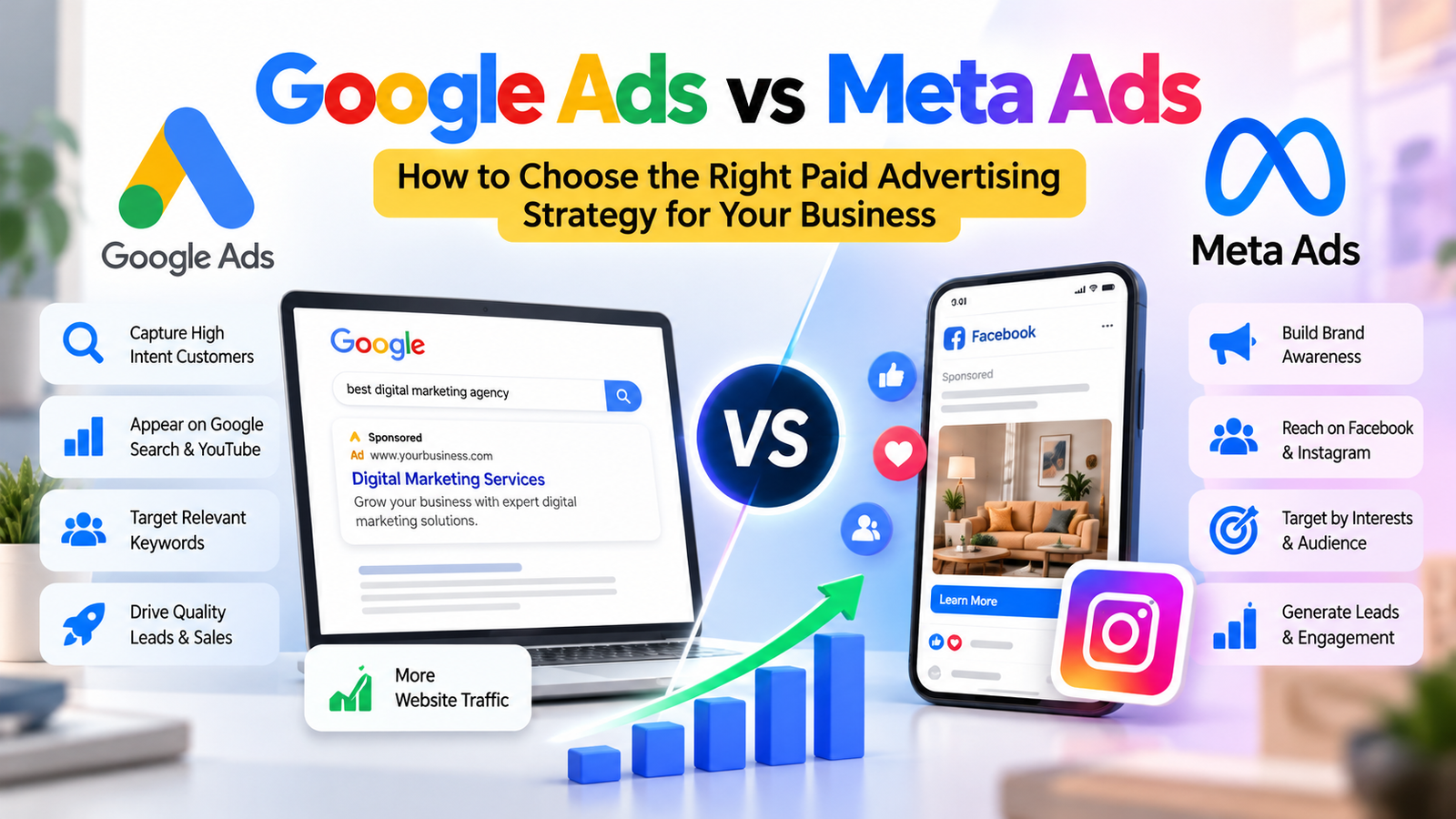
Businesses today have more opportunities than ever to reach potential customers online. However, choosing the right advertising platform can make a significant difference in how effectively a marketing budget is spent. Two of the most widely used options are Google Ads and Meta Ads, which allow businesses to connect with audiences at different stages of their buying journey.
But which platform is better for your business? Should you invest in Google Search campaigns, promote your brand through Facebook and Instagram, or combine both?
The answer depends on your business goals, target audience, customer behaviour, and advertising budget. Understanding these differences can help you build a paid advertising strategy that focuses on meaningful results rather than simply generating clicks.
What Are Google Ads and Meta Ads?
Google Ads is Google’s online advertising platform that helps businesses reach people through Google Search, YouTube, Display Network placements, and other eligible advertising inventory. It can be particularly useful when potential customers are actively searching for products, services, or solutions.
Meta Ads allows businesses to advertise across platforms such as Facebook and Instagram, depending on campaign settings and placements. It helps brands reach audiences based on available targeting signals, interests, engagement, and other eligible audience characteristics.
The main difference is how these platforms help businesses connect with potential customers. Google Ads can capture existing demand, while Meta Ads can help create interest and introduce products or services to relevant audiences.
Google Ads vs Meta Ads: Understanding the Key Differences
Choosing between these platforms becomes easier when you understand the role each one plays in a customer’s decision-making process.
1. Customer Intent
Google Ads can connect your business with people searching for specific solutions. For example, someone searching for “website development company in Noida” may already be comparing providers and preparing to contact one.
Meta Ads can introduce your business to people who may be interested in your offering but have not actively searched for it. A well-designed Facebook or Instagram advertisement can help them discover a product, understand its benefits, and consider taking action.
2. Audience Targeting
Google Ads targeting can use search keywords, location, language, audience signals, and other campaign-specific options. This is valuable when your advertising strategy depends on the services or products customers are searching for.
Meta Ads offers audience targeting options that can include location, demographics, interests, engagement, and eligible custom or lookalike audiences. These options can help businesses reach people based on their potential relevance to an offer.
Both platforms provide targeting capabilities, but the most suitable approach depends on the campaign objective and available audience data.
3. Creative and Content Requirements
Google Search campaigns often rely on relevant ad copy, compelling headlines, suitable landing pages, and a clear call to action.
Meta Ads places greater emphasis on visual storytelling for many campaign types. Images, short-form videos, carousels, demonstrations, and customer-focused creative concepts can help communicate the value of an offer.
Regardless of the platform, the advertisement should match the landing page and set accurate expectations for potential customers.
When Should Your Business Use Google Ads?
Google Ads may be a suitable choice when people are already searching for your products or services.
Consider the following examples:
- Local service businesses: Reach people searching for accountants, furniture suppliers, web developers, or other professional services in a specific area.
- High-intent enquiries: Target relevant searches from customers who are comparing providers or requesting quotations.
- Product-focused campaigns: Promote eligible products through relevant Google advertising formats.
- Time-sensitive demand: Reach potential customers searching for a solution when they need it.
For example, a corporate furniture supplier targeting businesses in Delhi NCR could use relevant search campaigns to reach organisations looking for office furniture, institutional furniture, or commercial furniture solutions.
The key is to target relevant searches, use suitable landing pages, and measure whether advertising generates qualified enquiries or sales.
When Should Your Business Use Meta Ads?
Meta Ads can be especially useful when your business needs to build awareness, demonstrate product value, or engage potential customers through visual content.
Here are some situations where Meta advertising may help:
- Brand awareness: Introduce your business to relevant audiences who may not know about your brand.
- Product discovery: Showcase product features, collections, demonstrations, or new launches.
- Lead generation: Encourage interested people to submit an enquiry through an eligible lead form or landing page.
- Remarketing: Re-engage eligible website visitors or people who have interacted with your business, subject to platform requirements and applicable privacy rules.
- Promotional campaigns: Communicate offers, events, seasonal campaigns, or new services.
For example, a furniture brand can use Instagram creatives to showcase contemporary office interiors, while Facebook campaigns can introduce product collections and direct interested users to relevant pages.
Successful Meta advertising requires more than attractive visuals. The creative concept, audience, offer, landing page, and follow-up process should work together.
Can Google Ads and Meta Ads Work Together?
Yes. Using both platforms can help businesses reach customers at different stages of the buying journey.
Imagine a company offering website development services.
First, Meta Ads introduces the company through a short video demonstrating its website design capabilities. Some people engage with the advertisement or visit the website.
At the same time, Google Search campaigns reach people actively searching for website development services. Both channels can direct potential customers to relevant landing pages, where they can explore services and submit enquiries.
A coordinated strategy may include:
- Discover: Use Meta Ads to introduce the brand and its offering.
- Capture demand: Use Google Ads to reach people searching for relevant services.
- Re-engage: Use eligible remarketing audiences to reconnect with previous visitors.
- Convert: Improve landing pages, enquiry forms, and follow-up processes.
- Measure: Review qualified leads, sales, conversion rates, and cost per acquisition.
This approach should be adapted to your audience and budget. Running both platforms is not automatically better; each campaign should have a clear purpose and measurable objective.
How Much Budget Should You Allocate to Paid Advertising?
There is no universal advertising budget that guarantees results. The right amount depends on your industry, competition, location, average order value, profit margins, and conversion rate.
Instead of dividing your budget equally between Google Ads and Meta Ads without evidence, begin by identifying your main objective.
For example:
- If your customers frequently search for your service, test Google Search campaigns with relevant keywords.
- If your product needs visual explanation or audience discovery, test Meta Ads with different creative concepts.
- If both search demand and audience discovery are important, run controlled campaigns on both platforms and compare their performance.
Start with a budget your business can sustain, establish conversion tracking, and evaluate performance before increasing spending.
Remember that advertising spend is only one part of the total cost. Creative production, landing page development, campaign management, and lead follow-up may also require investment.
Important Metrics to Track Before Scaling Campaigns
Clicks and impressions can indicate campaign reach, but they do not necessarily show whether advertising is generating business value.
Track the metrics that match your campaign objectives.
Click-through rate (CTR): Measures how often people click after seeing an advertisement.
Cost per click (CPC): Shows the average cost of each click.
Conversion rate: Measures the proportion of relevant visits or interactions that result in a defined conversion.
Cost per lead (CPL): Helps evaluate the advertising cost associated with generating a lead.
Customer acquisition cost (CAC): Estimates the cost of acquiring a customer across the relevant marketing and sales expenses.
Return on ad spend (ROAS): Compares attributed advertising revenue with advertising spend when reliable revenue tracking is available.
A campaign with inexpensive clicks may still produce poor business results if the traffic is irrelevant. Similarly, a campaign with a higher cost per click may be worthwhile if it consistently generates profitable customers.
Use properly configured conversion tracking and consider lead quality, attribution limitations, and the time it takes customers to make a decision.
Common Paid Advertising Mistakes Businesses Should Avoid
Even a well-funded campaign can underperform when its strategy is unclear. Businesses should watch for these common mistakes:
- Targeting broad or irrelevant audiences without a clear objective.
- Sending every advertisement to the homepage instead of a relevant landing page.
- Using generic ad copy that does not communicate a clear benefit.
- Ignoring mobile user experience and slow-loading pages.
- Measuring success only through clicks, likes, or impressions.
- Failing to track enquiries, purchases, or other meaningful conversions.
- Increasing budgets before identifying which campaigns generate valuable outcomes.
- Reusing the same creative and message across platforms without adapting to user behaviour.
Regular analysis can help identify wasted spend, improve campaign relevance, and guide future decisions.
How to Build a Smarter Paid Advertising Strategy
A practical advertising strategy begins with understanding your customers rather than selecting a platform first.
Start by defining the audience you want to reach, the problem your product or service solves, and the action you want customers to take. Research the search terms and audience characteristics relevant to your offer, then choose suitable campaign formats.
Create landing pages that answer customer questions, communicate clear benefits, and make it easy to enquire or purchase. Set up conversion tracking before launch so you can evaluate performance using meaningful data.
Finally, test your messaging, review campaign results, and make changes based on evidence. Paid advertising should be treated as an ongoing process of learning and improvement rather than a one-time setup.
Final Thoughts
Google Ads and Meta Ads serve different but complementary purposes in digital marketing. Google Ads can help businesses connect with people actively searching for solutions, while Meta Ads can support brand discovery, visual engagement, lead generation, and remarketing.
The right choice depends on your audience, business model, marketing objectives, and ability to convert interested users into customers.
For businesses that want to make better use of paid advertising, the priority should be building a strategy that connects audience research, relevant messaging, landing page experience, and accurate performance measurement.
At 247aimarketing, our focus is on helping businesses understand digital marketing opportunities and make informed decisions about reaching potential customers online. A well-planned advertising strategy starts with the right objectives and improves through consistent measurement and optimisation.
Ready to plan your next digital advertising campaign? Visit 247aimarketing to explore digital marketing solutions that align with your business goals.
Frequently Asked Questions
1. What is the main difference between Google Ads and Meta Ads?
Google Ads can reach people actively searching for relevant products or services, while Meta Ads can introduce businesses and offers to audiences across Facebook and Instagram based on available targeting options.
2. Are Google Ads better than Meta Ads for lead generation?
Neither platform is universally better. Google Ads may work well for high-intent searches, while Meta Ads can generate leads through targeted campaigns and lead forms. Performance depends on the audience, offer, campaign setup, and lead quality.
3. Can small businesses use both Google Ads and Meta Ads?
Yes. Small businesses can test one platform or both, depending on their goals and available budget. It is important to track meaningful conversions and evaluate results before expanding campaigns.
4. How do I measure the success of Google and Meta advertising?
Track conversions, cost per lead, lead quality, customer acquisition cost, and revenue where reliable tracking is available. Choose metrics that reflect the actual business objective.
5. Should I use the same advertisement on Google and Meta?
Not necessarily. Google Search advertisements should match search intent and relevant keywords, while Meta creatives often benefit from visual storytelling and audience-specific messaging. Adapt the content to the placement and campaign objective.
6. How long does it take to see results from paid advertising?
Campaigns can begin generating clicks and enquiries soon after launch, but consistent performance takes testing and analysis. The timeline depends on competition, budget, conversion tracking, offer quality, and the customer’s decision-making process.
7. Do Google Ads and Meta Ads require separate landing pages?
Not always, but each campaign should direct users to the most relevant page. Separate landing pages may be beneficial when audiences, offers, or search intent differ significantly.





1 comment on “Google Ads vs Meta Ads: How to Choose the Right Paid Advertising Strategy for Your Business”
Hi, this is a comment.
To get started with moderating, editing, and deleting comments, please visit the Comments screen in the dashboard.
Commenter avatars come from Gravatar.