
Updated October 2026 · By the 247 AI Marketing team · Video, paid ads and lead generation for growing businesses
How AI Video Marketing Can Help Businesses Generate More Leads in 2026
A website and a few social posts are no longer enough. People want to understand a product or service quickly, see how it solves their problem and decide whether a business is worth contacting. AI video marketing is becoming a core part of that journey. This guide covers how it can help with lead generation, brand awareness, paid campaigns and a stronger digital marketing strategy in 2026.
Quick answer: AI video marketing uses artificial intelligence to create, edit, personalize and distribute marketing videos, from scripts and voiceovers to subtitles and creative variations. It helps generate leads when the right video reaches the right audience and ends with a clear call to action. AI speeds up production, but results still depend on audience relevance, offer quality, landing pages and accurate measurement.
What is AI video marketing?
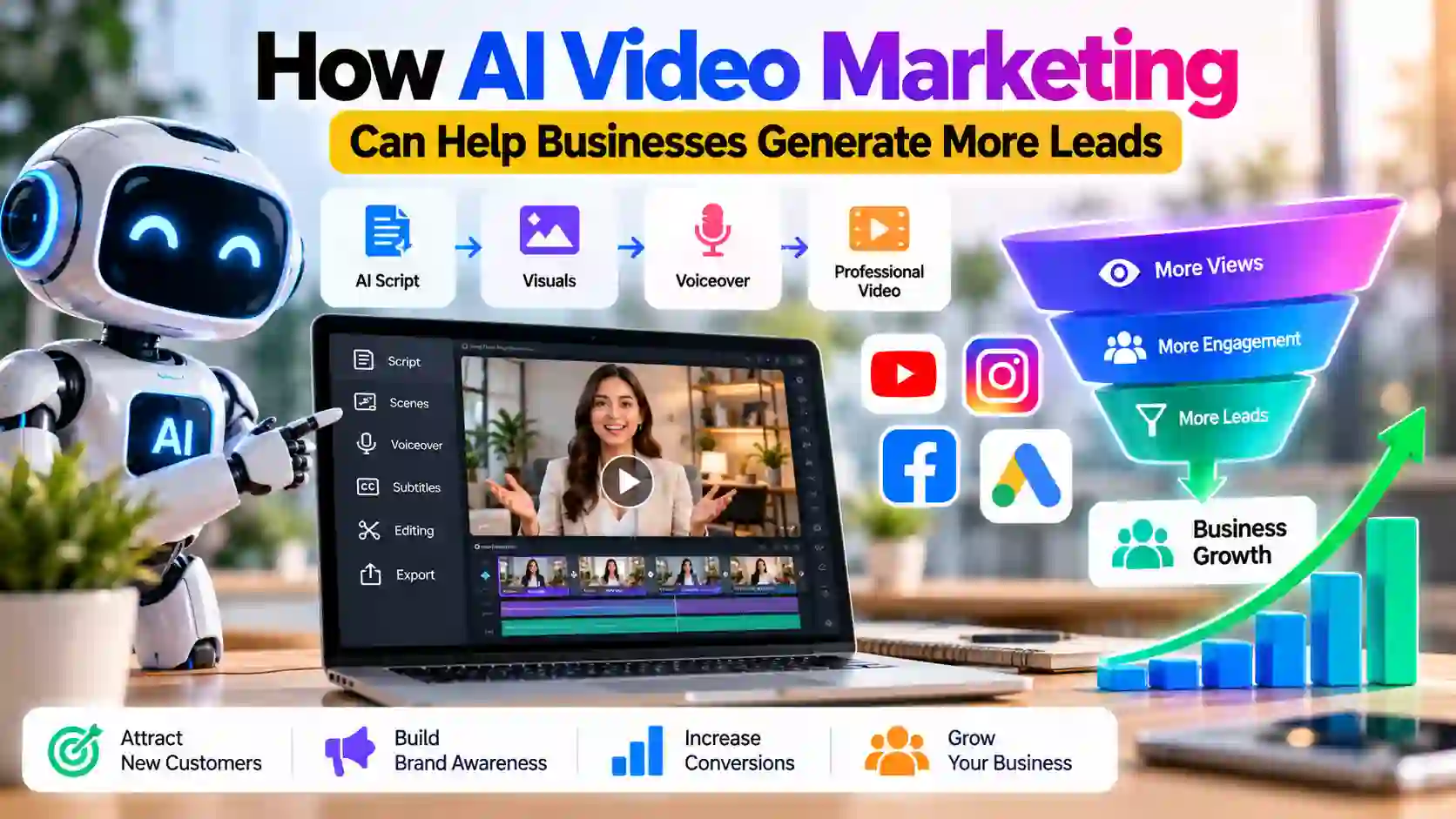
AI video marketing is the use of artificial intelligence tools to create, edit, personalize and distribute videos for marketing purposes. Instead of handling every production task manually, businesses can use AI to assist with scriptwriting, scene generation, voiceovers, subtitles, editing and creative variations.
A digital marketing agency can turn a written service description into a short promotional video. An online furniture store can develop product-focused video concepts. A local service provider can create educational videos explaining what it does.
| Objective | How video helps |
|---|---|
| Brand awareness | Introduces a brand to new audiences |
| Education | Explains products and services |
| Lead generation | Generates enquiries and sales leads |
| Paid advertising | Supports Google Ads and Meta Ads campaigns |
| Social content | Creates content for social media platforms |
| Promotions | Communicates offers, promotions and product benefits |
The purpose is not to produce more videos. It is to create relevant content that helps potential customers understand an offer and decide what to do next.
Why businesses are using AI video marketing in 2026
Video combines visuals, sound, demonstrations and storytelling in a single experience. AI tools make that format more accessible to businesses without large in-house creative teams. Four reasons stand out.
1. Faster content production
Fewer bottlenecks between idea and published video
Traditional production involves planning, locations, filming, editing and several revisions. AI tools can assist with many of these tasks, including scripts, voiceovers, scenes and campaign versions. That helps when a company needs multiple videos for different products, locations, audiences or platforms.
2. More creative testing
Find which message attracts relevant enquiries
An ad that works for one audience may not work for another. AI-assisted production makes it easier to vary messaging, visuals, hooks and calls to action. A furniture company might test three concepts:
- Modern office furniture designs.
- Space-saving furniture solutions.
- A complete office transformation.
Easier variations do not change the basics: performance still depends on audience relevance, offer quality, execution and accurate measurement.
3. Flexibility across platforms
One concept, many formats
A single idea can become vertical video for Reels and Shorts, landscape video for YouTube or a shorter cut for ad placements. Each format may need a different opening scene, subtitles, pacing, visuals and call to action. AI-assisted editing helps prepare these versions without rebuilding every video from scratch.
4. Opportunities for smaller businesses
Lower barriers, not zero effort
Smaller businesses can explore AI-generated visuals, synthetic voiceovers, animated explainers and template-based formats. These can reduce some production requirements, although professional editing, creative direction, paid tools and human review may still be needed. Choose the method that suits your brand, budget, audience and the video’s purpose.
How AI video marketing helps generate more leads
A lead is a potential customer who submits a contact form, requests a quotation, books a consultation or calls your business. An effective video does more than attract attention. It helps viewers understand the offer and gives them a clear reason to take the next step.
1. Explain your services clearly
Some services are hard to convey in a paragraph or a static image. Video can demonstrate a process, explain benefits and answer common questions. An accounting firm could explain bookkeeping for small businesses, and a web development agency could show how a professional website helps customers find services and submit enquiries. AI tools can turn these ideas into structured scripts, narrated explainers and visual demonstrations. When viewers understand the offer, they tend to feel more confident about getting in touch.
2. Create problem-solving videos
People often search for solutions before choosing a provider. Educational videos can answer those questions through social media, landing pages and suitable ad campaigns. Useful topics include:
- How can a small business improve its online visibility?
- What should you check before choosing an accounting service?
- How can a furniture supplier help create a more productive office?
- Why does a business need a properly structured website?
Give genuine value rather than relying on promotional messaging alone.
3. Use clear calls to action
Without a clear next step, people may watch the video and still not know how to proceed. Depending on the campaign, strong calls to action include request a quotation, book a consultation, explore our services, view the complete product range, contact our team or visit our website.
4. Develop audience-specific videos
A startup may want affordable marketing, while an established company may care more about scalability, reporting and campaign management. AI-assisted workflows can help you develop alternative scripts and concepts for each segment. Personalization should rely on relevant, appropriate information. Avoid misleading claims, and do not use sensitive personal characteristics in ways that break advertising policies or privacy requirements.
AI video marketing with Google Ads and Meta Ads
Both platforms can carry video, but they reach people differently. Google Ads can connect with people searching for products or services and with audiences who respond to video ads. Meta Ads distributes video across Facebook, Instagram and eligible placements. AI-assisted video assets can support suitable formats on either platform, subject to current specifications and advertising policies.
Using video in a Google Ads strategy
- YouTube advertisingIntroduce your brand, demonstrate products, explain services and send viewers to a relevant landing page. A marketing company could show how it plans campaigns, tracks conversions and analyzes performance. The opening seconds should say why the video matters to the viewer.
- Product and service demonstrationsUse video where a demonstration beats a static image. AI can assist with storyboarding, narration, editing and visuals, while marketers verify that the final video represents the product or service accurately.
- Test creative conceptsExperiment with openings, value propositions, lengths and calls to action. One version might focus on saving time and another on practical service benefits. Judge them on conversions, qualified enquiries and cost per lead.
Video alone does not guarantee better Google Ads results. Campaign objective, targeting, landing page, bidding strategy and conversion tracking still matter.
Using video in a Meta Ads strategy
- Engaging Reels and short-form adsShort video can deliver a product benefit or service message quickly. A furniture brand could show a modern office setup, highlight storage and invite viewers to explore the collection. Establish the subject early, then give a reason to keep watching.
- Visual storytelling for productsDevelop concepts around features, use cases and customer needs. Keep every generated scene and product representation accurate: AI visuals should never misrepresent appearance, functionality or real customer experiences.
- Test advertising messagesRun versions that highlight convenience, product quality or a specific service benefit. The goal is to learn which approach attracts the most relevant audience and meaningful business outcomes.
- Support lead generationSend interested viewers to a landing page or an eligible Meta lead form. Explain the offer, show why it matters and make the next step easy. Have a process ready to respond to and qualify enquiries.
Related reading: our guide to a Predictive AI Funnel for Meta Ads.
AI video marketing ideas for different industries
AI video is not limited to technology companies or large brands. Pick an industry to see video formats that fit and what to double-check before publishing.
Video ideas by industry
Always review AI-generated scenes before publishing and label them clearly where they depict imagined or modified content.
What makes an effective AI marketing video?
AI can assist with production, but the strategy behind the video decides how well it communicates. Use this checklist before you publish. Tick each item as you confirm it.
Pre-publish video checklist
The aim is to combine AI-assisted production with thoughtful creative decisions and a clear understanding of your audience.
How to measure the results of AI video marketing
Evaluate campaigns against their objectives rather than assuming high view counts mean sales. Each metric explains a different part of the customer journey.
| Metric | What it tells you | Keep in mind |
|---|---|---|
| Video engagement | Views, watch time and retention show whether people are watching | Read it using each platform’s definitions and your campaign objective |
| Click-through rate | How often viewers click after seeing the ad | Shows whether creative and message prompt action |
| Cost per lead | Ad cost associated with generating a lead | Check that leads are relevant and likely to become customers |
| Conversion rate | How well interactions lead to a defined action, such as an enquiry or purchase | Define the action before launch |
| Customer acquisition cost | Cost of acquiring customers across marketing and sales | A broader view than ad clicks alone |
| Return on ad spend | Attributed revenue compared with ad spend | Needs reliable revenue tracking |
A practical report combines these numbers with lead quality, sales outcomes and the wider business goal. Attribution methods and measurement limits can affect the figures, so interpret them carefully.
Common AI video marketing mistakes to avoid
AI speeds up production, but it cannot replace marketing judgment.
| Mistake | Why it hurts |
|---|---|
| Creating videos without a strategy | Every video needs a purpose, audience and intended action |
| Using generic scripts | Content should answer real customer questions, not repeat broad promotional statements |
| Prioritizing quantity over quality | More videos do not help if they lack relevance or accuracy |
| Ignoring platform requirements | Dimensions, duration and captions should match the placement |
| Using misleading AI visuals | Products, services, testimonials and results must be shown honestly |
| Ignoring landing pages | A strong ad underperforms if the destination is confusing, slow or irrelevant |
| Failing to measure conversions | Views and engagement are not substitutes for business outcomes |
| Overlooking privacy and usage rights | Use proper permissions for images, voices, music and customer information |
The future of AI video marketing in 2026
Generative video, synthetic narration, editing automation, multilingual production and creative personalization keep widening what marketers can try. One key development is producing variations of a central concept for different audiences and placements, so you can test messages that reflect different customer needs instead of running one ad everywhere.
Another opportunity is connecting video to the wider marketing system. A business might use educational videos to introduce a service, search ads to capture relevant demand and follow-up campaigns to re-engage interested audiences. Still, success depends on customer understanding, credible messaging, quality control and measurable outcomes. AI assists the process; people decide what to say and why.
Work with 247 AI Marketing
AI video marketing gives businesses new ways to communicate value, explain services and reach potential customers. The strongest results come from pairing suitable AI tools with clear messaging, relevant audiences, effective landing pages and reliable measurement. The first step is to identify a customer problem, develop a useful message and choose a video format that supports the outcome you want.
At 247 AI Marketing, we connect creative content with broader online growth strategies, including paid advertising and search visibility. Explore our Google Ads and Meta Ads services or visit the 247 AI Marketing homepage.
AI video marketing: FAQs
What is AI video marketing?
AI video marketing uses artificial intelligence tools to assist with creating, editing, personalizing and distributing videos for business promotion, brand awareness, lead generation and advertising.
Can AI video marketing help generate leads?
Yes. AI-assisted videos can explain services, showcase products, answer customer questions and direct viewers to enquiry forms or landing pages. Actual lead generation depends on the audience, offer, creative quality and conversion process.
How can businesses use AI videos for Google Ads?
Businesses can use suitable AI-generated or AI-assisted videos for eligible Google advertising formats, including YouTube campaigns. They should follow platform requirements, use accurate messaging and measure conversions against campaign objectives.
Can AI video marketing be used for Facebook and Instagram ads?
Yes. Businesses can use AI-assisted videos for suitable Facebook and Instagram placements. Effective campaigns typically combine relevant creative, a clear offer, suitable audience targeting and an appropriate call to action.
Is AI video marketing suitable for small businesses?
Yes. Small businesses can use AI-assisted workflows for promotional videos, service explainers, product demonstrations and social content. The best format depends on budget, business objectives and audience.
Does AI video marketing guarantee more sales?
No. AI video production does not guarantee leads, conversions or revenue. Results depend on customer demand, creative quality, advertising strategy, landing pages, competition and sales follow-up.
How can I measure the success of AI video marketing?
Evaluate video engagement, watch time, click-through rate, cost per lead, conversion rate, customer acquisition cost and return on ad spend where appropriate. The most important metrics are those that reflect the campaign’s actual objective.
Should businesses replace traditional video production with AI?
Not necessarily. AI-assisted production suits explainers, creative testing and certain promotional formats. Traditional filming may remain preferable when authenticity, real people, physical locations or detailed product demonstrations are essential.
How often should a business publish AI marketing videos?
There is no single ideal frequency. Prioritize consistency, relevance, quality and the needs of each platform, and review audience engagement and business outcomes to set a schedule.
What should businesses consider before creating AI-generated marketing videos?
Define your audience, message, budget and objective first. Then check factual accuracy, brand consistency, platform specifications, privacy requirements and rights to any images, voices, music or other assets used.
Ready to explore AI-powered video marketing?
See how video content can support your digital marketing goals with 247 AI Marketing.
Talk to our team