
Updated October 2026 · By the 247 AI Marketing team · Paid social strategy for brands scaling on Meta
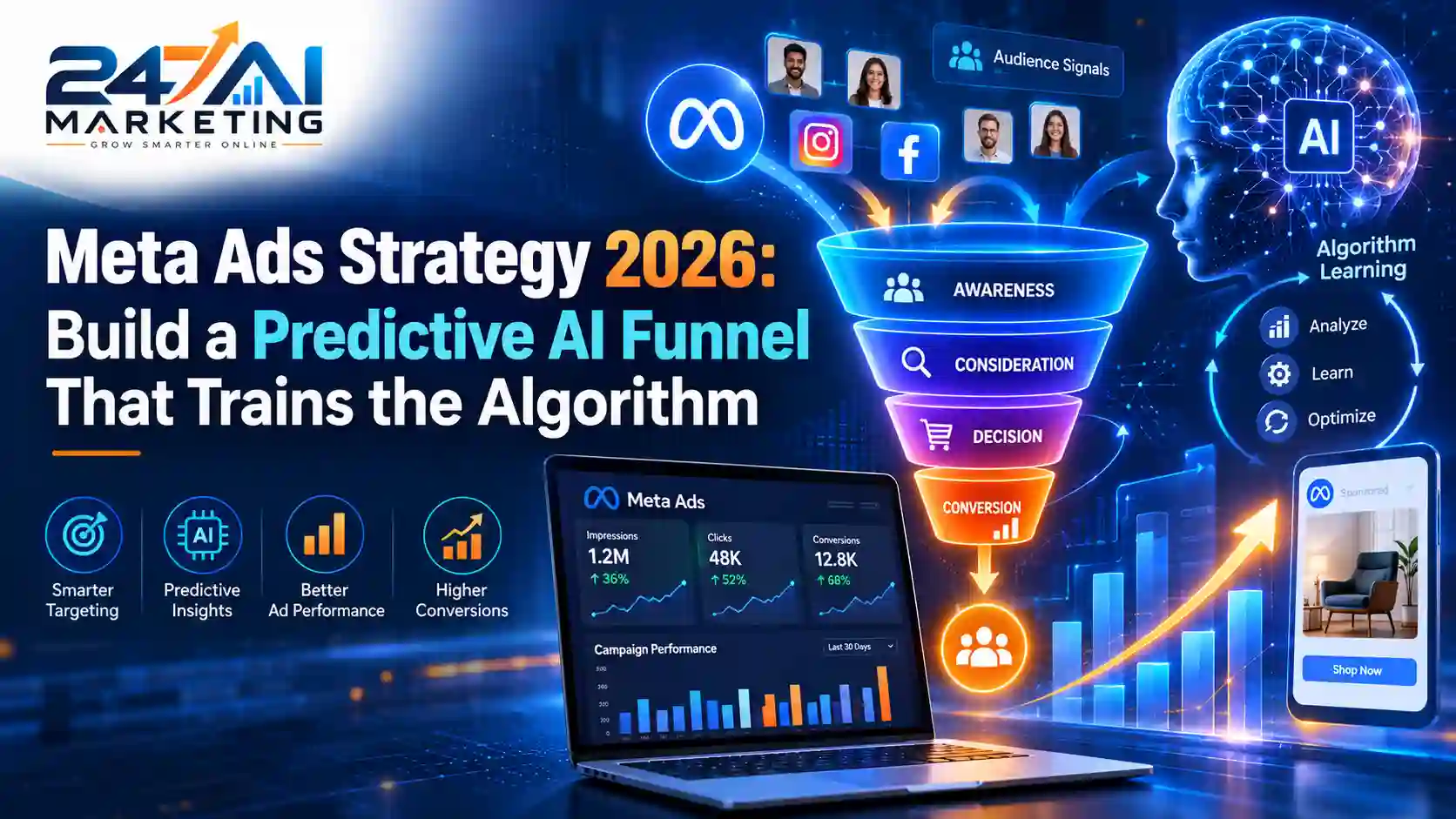
Meta Ads Strategy 2026: Build a Predictive AI Funnel That Trains the Algorithm
For years, media buyers treated Meta Ads like a sniper rifle: stacked interests, strict demographics and dozens of micro ad sets. With privacy updates, signal loss and cookie deprecation, that approach now leads to high costs and burnt-out accounts. This guide shows how to restructure your Meta Ads for algorithmic efficiency using a Predictive AI Funnel.
Quick answer: A Predictive AI Funnel stops trying to outsmart Meta and starts training it. It rests on four pillars: broad-first targeting, Dynamic Creative Matrixing, first-party offline conversion loops through the Conversions API, and creative fatigue mitigation. The goal is to feed Advantage+ the right behavioral and conversion signals so it finds buyers during the latent phase of intent, before they ever search.
Why micro-targeting stopped working on Meta
The old playbook relied on precision: niche interest categories, narrow demographic boundaries and manual tests across many small ad sets. Privacy updates, signal loss and cookie deprecation changed what that approach can deliver. Today, manual audience micro-targeting tends to raise costs and wear accounts out.
The modern shift is a change of role. Advertisers become trainers of the algorithm rather than rivals of it. Meta’s Advantage+ architecture performs best when it receives strong behavioral and conversion signals, and the Predictive AI Funnel is the system for supplying them.
Traditional targeting vs the Predictive AI Funnel
| Strategy element | Traditional Meta Ads | Predictive AI Funnel (APF) |
|---|---|---|
| Audience structure | Micro-targeted interests and lookalikes | Broad-first and Advantage+ automation |
| Creative approach | Static, single-ad formats | Dynamic Creative Matrixing (DCM) |
| Optimization goal | Clicks, cheap leads, superficial engagement | Deep-funnel LTV and offline CAPI loops |
| Algorithm role | Tool that executes manual rules | Autonomous partner trained via data signals |
The 4 pillars of a Predictive AI Funnel
Each pillar answers three questions: what it is, why it matters to the algorithm, and what to do about it.
Pillar 1: Broad-first and zero-targeting architecture
Trust the machine; let the creative do the targeting
- What it is
- Moving away from manual interest stacking and lookalike percentages toward broad or Advantage+ Audience structures.
- Why it matters for AI
- Meta’s neural networks evaluate thousands of real-time signals, from device type and scroll velocity to watch time and historical purchase behavior. Human marketers cannot track these manually, and restrictive interest layers artificially choke the algorithm’s ability to find buyers.
- Actionable execution
- Consolidate your structure. Replace fragmented, low-budget ad sets with Campaign Budget Optimization (CBO) setups and broad targeting.
- Let the ad creative do the targeting. Your words, hooks and imagery repel uninterested users and attract qualified prospects.
Pillar 2: Dynamic Creative Matrixing (DCM)
If broad targeting is the engine, creative is the fuel
- What it is
- Modular creative assets that Meta’s AI mixes and matches, combining hooks, body copy, value propositions and calls-to-action for each unique impression.
- Why it matters
- Different segments respond to different psychological triggers, such as status, cost-savings or speed. A single static image or video limits the algorithm’s ability to personalize. DCM lets it serve the variation most likely to convert a specific user.
- Actionable execution
- Build a matrix with 3 hook variations, 2 body texts and 2 visual styles per asset group.
- Prioritize short-form video, including UGC and founder-led content, designed to capture attention in the first 2 seconds.
Pillar 3: First-party offline conversion loops
Optimize for revenue, not vanity metrics
- What it is
- Feeding high-value offline conversions, CRM data and customer lifetime value (LTV) metrics back into Meta’s Conversions API (CAPI).
- Why it matters
- Optimizing only for front-end metrics like cost-per-click (CPC) or standard lead form fills trains the AI to find cheap, low-intent users who never buy. Deep-funnel data shifts optimization from volume to value, so Meta hunts for users who mirror your highest-paying customers.
- Actionable execution
- Implement robust CAPI event tracking alongside your standard browser pixel.
- Pass event quality scores and customer value parameters back to Meta so the algorithm optimizes for revenue.
Pillar 4: AI-driven creative fatigue mitigation
Refresh before frequency runs away
- What it is
- An automated, systematic pipeline that refreshes ad creative before frequency metrics scale out of control.
- Why it matters
- Even the best AI-driven accounts hit a wall when creative fatigue sets in and Cost Per Acquisition (CPA) spikes. The algorithm relies on fresh data inputs, and stagnant creative forces it to show ads to the same saturated pools.
- Actionable execution
- Monitor hook rates and drop-off rates weekly instead of waiting for overall CPA to jump.
- Keep a continuous iteration schedule, adding fresh variations into winning campaigns without resetting their learning phases.
Creative matrix builder: how many variations does the AI get?
Pillar 2 recommends 3 hooks, 2 body texts and 2 visual styles per asset group. Adjust the numbers below to see how quickly modular assets multiply into combinations Meta can test for you.
Creative combinations per asset group
Illustrative arithmetic only: hooks × body texts × visual styles. Real delivery depends on your account and budget.
Restructure your account: before and after
The fragmented, micro-targeted account
- Many small ad setsLow budgets split across niche interest stacks and lookalike percentages.
- Single static adsOne image or video per ad, so little room to personalize.
- Front-end optimizationClicks, cheap leads and form fills drive decisions.
- Reactive refreshesCreative changes only after CPA has already jumped.
Result: restricted signal, shallow data and rising costs.
The consolidated, trained account
- Consolidated CBO campaignsSpend bundled into broad or Advantage+ Audience ad sets.
- Modular creative matrixHooks, body copy and visuals that Meta’s AI recombines per impression.
- CAPI-powered optimizationOffline conversions, CRM data and LTV signals feed back to Meta.
- Scheduled creative pipelineWeekly hook-rate and drop-off checks, with new variations added to winners.
Result: the algorithm optimizes for value, not volume.
Rollout checklist: moving to a Predictive AI Funnel
A practical order of operations, built from the four pillars. Move through it in sequence so each step gives the next one better data.
| Step | Action | Pillar |
|---|---|---|
| 1 | Audit current ad sets and consolidate fragmented spend into CBO with broad or Advantage+ targeting | Pillar 1 |
| 2 | Set up CAPI alongside the browser pixel and pass CRM, offline and LTV data back to Meta | Pillar 3 |
| 3 | Build the creative matrix: 3 hooks, 2 body texts, 2 visual styles, with short-form video first | Pillar 2 |
| 4 | Launch, then review hook rates and drop-off rates weekly | Pillar 4 |
| 5 | Add fresh variations to winning campaigns on a steady schedule, without resetting learning | Pillar 4 |
Metrics to watch and what they tell you
| Metric | What it signals | Action |
|---|---|---|
| Hook rate | Whether the first seconds capture attention | Test new hooks before CPA rises |
| Drop-off rate | Where viewers lose interest | Rework body copy and pacing |
| Frequency | How saturated your audience pool is | Introduce fresh creative |
| CPA | Lagging sign of fatigue or weak signals | Check creative and CAPI data quality |
| Customer value / LTV | Whether Meta is finding high-paying buyers | Keep passing value parameters through CAPI |
Mistakes that hold Meta Ads back
Stacking restrictive interest layers. This artificially chokes the algorithm’s ability to find buyers. Running one static ad. It limits personalization for each user. Optimizing for CPC or basic lead forms. This trains the AI to find cheap, low-intent users who never buy. Waiting for CPA to spike. By then fatigue has already set in; weekly hook and drop-off checks catch it earlier.
Work with 247 AI Marketing
The days of outsmarting Meta with clever audience hacks are over. Success in paid social now belongs to brands that master algorithmic training, feed clean first-party data loops and deploy dynamic creative matrices. A Predictive AI Funnel turns Meta’s machine learning into an engine that uncovers buyer intent before competitors know people are looking.
Explore our Meta Ads and Google Ads services or visit the 247 AI Marketing homepage to see how we put these frameworks into practice.
Meta Ads strategy: FAQs
What is a Predictive AI Funnel in Meta Ads?
It is a way of structuring Meta Ads so you feed Advantage+ the right behavioral and conversion signals instead of micro-managing audiences. It combines broad targeting, dynamic creative, first-party conversion data and a creative refresh pipeline.
Why has manual audience micro-targeting stopped working?
Privacy updates, signal loss and cookie deprecation reduced what manual targeting can achieve. Stacking niche interests and running many small ad sets tends to lead to high costs and burnt-out ad accounts.
What is broad-first targeting?
It means moving from manual interest stacking and lookalike percentages to broad or Advantage+ Audience structures, so Meta’s AI can use thousands of real-time signals to find buyers.
What is Dynamic Creative Matrixing?
It is a modular creative approach where Meta’s AI mixes hooks, body copy, value propositions and calls-to-action for each impression. A common starting point is 3 hooks, 2 body texts and 2 visual styles per asset group.
Why use the Conversions API (CAPI)?
CAPI lets you send high-value offline conversions, CRM data and customer lifetime value back to Meta. That shifts optimization from cheap clicks and lead fills toward users who resemble your best customers.
How do I prevent creative fatigue?
Monitor hook rates and drop-off rates weekly, and keep a steady schedule of fresh creative variations inside winning campaigns so you avoid resetting their learning phases.
Does broad targeting mean I stop caring about my audience?
No. Your creative does the targeting. The words, hooks and imagery in your ad attract qualified prospects and repel uninterested users.
Ready to elevate your paid social performance?
Explore expert execution and cutting-edge AI marketing frameworks with 247 AI Marketing.
Talk to our team