
Updated 21 October 2026 · By the 247 AI Marketing team
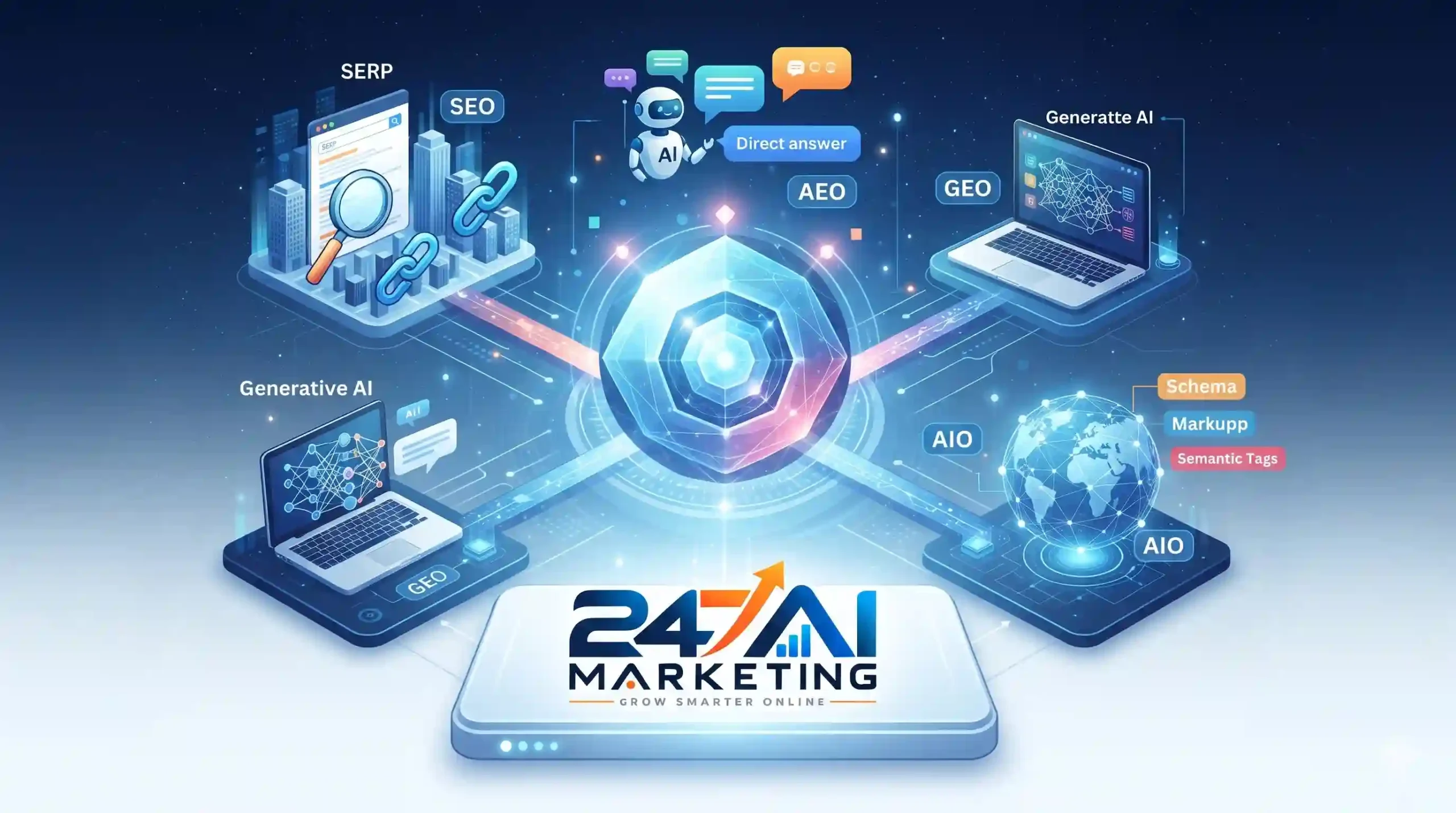
The Quad-Layer Search Framework: How SEO, AEO, GEO & AIO Work Together
For over two decades, digital marketing had one North Star: rank on page one, capture the click and convert the visitor. That model has changed. People now type queries into AI chatbots, conversational agents and search interfaces that return synthesized answers and AI-generated overviews instead of just ten blue links. This guide shows how to unify SEO, AEO, GEO and AIO into one organic growth system.
Quick answer: The Quad-Layer Search Framework combines four layers: SEO (technical foundation and keywords), AEO (direct answers and snippets), GEO (citations inside AI-generated answers) and AIO (machine-readable entity signals). Traditional SEO stays the foundation; the other three build on top of it.
Why the ten blue links are no longer enough
When users ask a question today, they often get an instant synthesized answer before they ever see a list of websites. If your strategy only focuses on keyword placement, your brand can be invisible to modern buyers, even when you rank.
To keep up, brands need a complete digital ecosystem. That is the Quad-Layer Search Framework: four connected layers that together make your content rankable, extractable, citable and machine-readable. If you want a team to run all four for you, see how our digital marketing agency in India approaches it.
The four layers explained
Pick a layer to see what it is, why it matters and exactly what to do.
Layer 1: Traditional SEO, the raw material foundation
Many marketers assume newer paradigms replace traditional Search Engine Optimization. In reality, SEO is the absolute foundation.
Actionable execution
- Fix broken internal links and eliminate crawl errors.
- Optimize site speed so both human users and heavy automated scrapers can load pages smoothly.
- Maintain keyword rigor, focusing on semantic relevance and user intent over rigid keyword density.
Need help with this layer? Explore our SEO services.
Layer 2: AEO (Answer Engine Optimization), capturing the direct extraction
Once the technical foundation is secure, the next layer targets zero-click ecosystems, voice search and featured snippets.
Actionable execution
- The Inverted Pyramid Rule: answer the core question in a definitive 40 to 60-word block right at the start of each section.
- Implement FAQ schema: wrap questions and answers in FAQ and HowTo schema markup so machines can parse them easily.
This very guide uses the pattern: look at the quick answer box near the top and the FAQ section at the end.
Layer 3: GEO (Generative Engine Optimization), winning the AI citation war
As discovery shifts to generative platforms, Google AI Overviews and conversational engines, GEO decides whether your brand is cited as a trusted source.
Actionable execution
- Prompt cluster mapping: build content around conversational prompt clusters (for example, “What is the best AI marketing architecture for B2B firms?”) instead of isolated short-tail keywords.
- Statistical density: LLMs favor proprietary data, original case studies and distinct figures. Include unique charts, data points and expert quotes that AI can attribute to your domain.
Layer 4: AIO (Artificial Intelligence Optimization), the machine-readable ecosystem
While GEO focuses on text generation and citations, AIO is the overarching infrastructure that ensures total machine readability.
Actionable execution
- Audit robots.txt and meta tags so leading AI search bots have explicit reading access.
- Deploy complete Organization, WebSite and LocalBusiness schema markup.
- Build consistent off-site digital PR and brand mentions to solidify real-world entity authority.
Want to know who is behind the brand signals we build? Read about 247 AI Marketing.
Quad-Layer breakdown at a glance
| Layer | Focus / goal | Primary mechanism | Target destination |
|---|---|---|---|
| SEO | Technical health and crawlability | Keywords, Core Web Vitals, backlinks | Traditional search index |
| AEO | Direct answers and snippets | 40-word answer blocks, FAQ schema | Voice search, People Also Ask, featured snippets |
| GEO | Narrative citations in LLMs | Prompt clusters, original data | Chatbots, Perplexity, AI Overviews |
| AIO | Machine-readable ecosystem | Semantic HTML, entity schema | Universal AI knowledge graphs |
Your quad-layer checklist
Tick off what your site already does. Your progress is only shown on this page and is not saved or sent anywhere.
0 of 10 done
Stuck on more than a few items? Contact us for an audit of where your brand stands across all four layers.
Common mistakes to avoid
Treating AEO, GEO and AIO as replacements for SEO
They are layers, not substitutes. Broken crawlability stops every other layer from working.
Keyword stuffing
Brands that cling to keyword stuffing risk ending up stranded in zero-click obscurity. Focus on semantic relevance and user intent instead.
Blocking AI bots by accident
A restrictive robots.txt file can quietly keep valuable AI indexing bots away from your best content.
Publishing generic content with no original data
If every claim on your page is available everywhere else, an AI engine has no reason to attribute it to you.
Quad-Layer Search FAQs
What is the difference between SEO, AEO, GEO and AIO?
SEO builds the technical and keyword foundation, AEO structures content for direct answers and snippets, GEO earns citations inside AI-generated summaries, and AIO makes your whole site and brand entity machine-readable.
Does AEO or GEO replace traditional SEO?
No. Traditional SEO is the foundation. AI engines and crawlers need clean site structure, fast indexation and sitemaps to read your content in the first place.
How long should an AEO answer block be?
Aim for a definitive answer of about 40 to 60 words placed at the very start of the relevant section, followed by the detail.
What schema markup helps most?
FAQ and HowTo schema support answer engines, while Organization, WebSite and LocalBusiness schema help AI systems recognise your brand as a clear entity.
Where should I start if my site is new to all of this?
Start with Layer 1. Fix crawl errors, speed and sitemap issues first, then add answer blocks and schema, then original data, then entity and crawler-access work.
Conclusion: future-proofing your brand with an AI-first strategy
The move from traditional search optimization to a multi-dimensional framework is no longer a prediction; it is the current baseline for digital marketing success. Brands that rely on keyword stuffing will be stranded in zero-click obscurity, while those that master SEO, AEO, GEO and AIO can capture continuous, high-intent traffic.
Ready to become an AI-first market leader?
247 AI Marketing builds custom search architectures across all four layers. Start with our SEO services, learn about our team, or head back to the 247aimarketing.com homepage.